
For a long time, we have been taught to associate weight with luxury, particularly when it comes to bath towels and bath sheets, where thick, dense and heavy have become shorthand for quality, and somewhere along the way the number attached to GSM became part of that equation too: the higher the number, the more luxurious the towel must be. I understood the logic because I had made exactly the same assumption, but once we started developing the SunGods Founder Bath Sheet and looking at the product not simply as something that needed to feel beautiful when you picked it up in a shop, but as something that would be used, washed, dried, carried, stored and lived with repeatedly, I started questioning whether heavier automatically meant better.
Our first development sample came in at around 620 GSM and, on paper, there was plenty about that number that sounded luxurious; it was substantial, reassuringly heavy and very much what we have come to expect a premium bath product to feel like, but actually living with it raised a much more useful question.
Did we really need all that weight?
The answer, eventually, was no.
The SunGods Founder Bath Sheet is now approximately 345 GSM, and getting there wasn't about removing quality from the product or making something lighter simply to use less material; it was about understanding what we actually wanted the bath sheet to do and then designing the weight, construction and size around the way it would be used in everyday life.
GSM simply means grams per square metre, a measurement of fabric weight that tells us how many grams one square metre of a particular textile weighs, and while it is a useful specification for comparing fabrics, it doesn't independently tell us whether one textile is softer, more absorbent, more durable, better made or more luxurious than another.
That distinction is important because numbers are wonderfully easy to market.
A 700 GSM towel sounds more substantial than a 500 GSM towel, just as a high thread count can sound more impressive on a bedding label, but textile performance is rarely determined by one number in isolation; fibre selection, yarn construction, weave, finishing, density and the way those decisions interact all contribute to what the finished fabric eventually becomes.
In our case, GSM became one design variable within a much larger material and construction system rather than a number we wanted to maximise.
Once we looked at it that way, the question stopped being how heavy can we make this bath sheet? and became how much weight does it actually need?

There is something useful about finally receiving a physical sample after months of looking at specifications, drawings, fibre percentages and manufacturing conversations, because suddenly all of those decisions stop being theoretical and become something you can actually live with.
The first heavier bath sheet gave us exactly that opportunity.
We could shower with it, wrap it around ourselves, hang it up, wash it, dry it, fold it and put it away, which meant we were no longer evaluating the product for the few seconds somebody might spend touching it in a store; we were evaluating what it was like to own.
That difference matters.
A heavy bath sheet can feel wonderful when it is clean, dry and folded beautifully on a shelf, but that isn't where it spends its life. It spends its life moving between your body, the bathroom, the washing machine, the drying line or dryer and the linen cupboard, and once we started considering all of those moments together, the extra weight stopped automatically feeling like an advantage.
The bath sheet needed to feel substantial enough to be comforting, but not so substantial that every other part of living with it became harder.

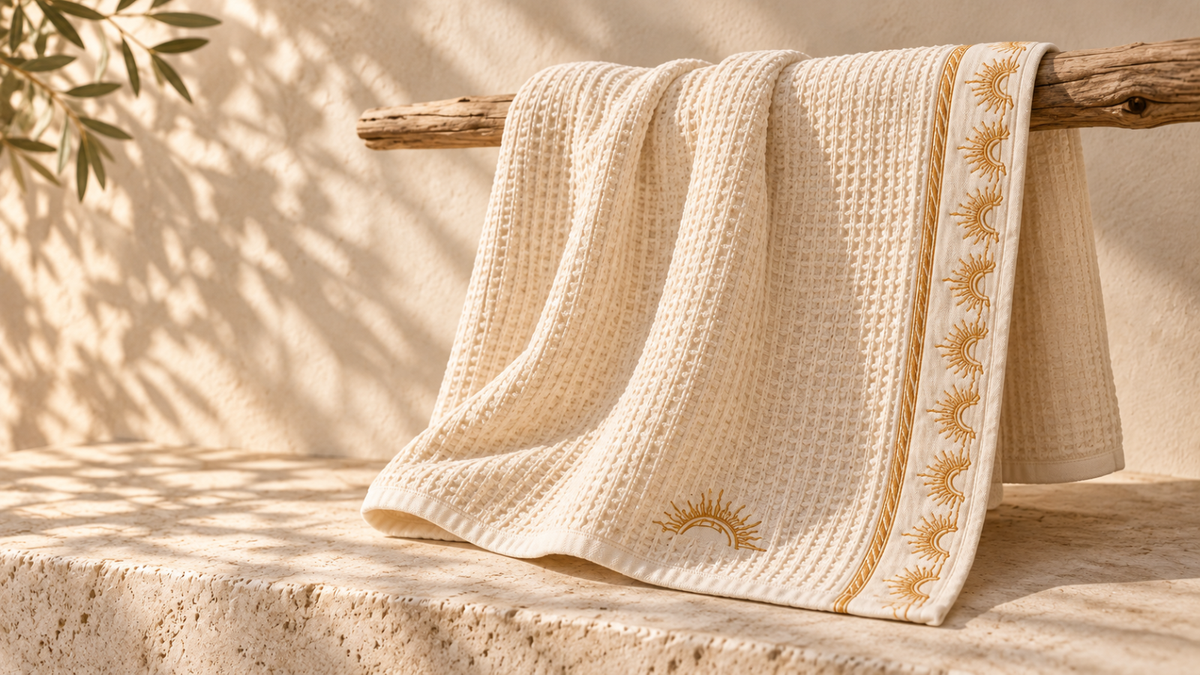
The decision to move towards 345 GSM also cannot really be separated from the decision to use a waffle construction, because the structure of the fabric changes the way we experience its weight.
Waffle is dimensional.
Rather than creating a completely flat surface, the woven structure creates a textured network across the fabric, giving it physical depth without requiring us to achieve that character simply by adding more and more mass.
That became particularly interesting because we weren't trying to make a conventional terry towel lighter; we were developing a different kind of bath sheet.
The waffle construction allowed us to think about texture, surface area, hand feel and weight together, and it meant that reducing the GSM didn't necessarily translate into creating something that felt insubstantial.
This is where specifications become slightly deceptive, because 345 GSM written on a page tells you the weight of the fabric, but it doesn't tell you what the fabric feels like in your hands.
You have to experience the construction.

There was another decision happening at exactly the same time, because the bath sheet itself changed size during development.
We had originally been working around 100 × 180 cm, but the Founder Bath Sheet ultimately moved to 170 × 90 cm, and while ten centimetres in either direction might not sound particularly consequential, when you are working across the entire surface of a textile those dimensions affect the total amount of fabric, the finished weight of the product and how it behaves when somebody actually uses it.
Again, we came back to the same question: what does the product need to do?
It needs to wrap comfortably around the body, work in a real bathroom, hang without overwhelming the space, fit into a normal washing load and still give you the generous experience we wanted from a bath sheet.
We weren't trying to win a competition for the largest towel.
We were trying to get the proportions right.
This is probably where my own definition of luxury has changed most through building SunGods, because I increasingly think luxury has very little to do with how impressive a product appears at the moment of purchase and much more to do with how well considered it feels once it becomes part of your life.
A bath sheet that feels extraordinary for thirty seconds but becomes cumbersome every time it needs to be washed isn't necessarily a better-designed product.
The laundry is part of the product experience.
So is drying.
So is storage.
So is carrying it to the beach or packing it into a bag.
So is hanging it back on the rail the following morning.
When we started looking at the Founder Bath Sheet through that lens, lighter began to make considerably more sense, because reducing unnecessary weight had the potential to make several of those everyday interactions easier without abandoning the feeling, scale and texture we wanted from the product.
This isn't about claiming that 345 GSM is universally better than 500, 600 or 700 GSM, because different constructions and different products are designed to do different things.
It is about saying 345 GSM made sense for this bath sheet.
That is a much more honest design argument.

There is a broader principle sitting behind this decision that extends well beyond towels, because we live in a culture where more is very easily interpreted as better: more weight, more features, more packaging, more ingredients, more technology, more product.
Yet thoughtful design often requires the opposite discipline.
What can we remove without compromising the experience?
What does the product genuinely need?
What are we adding because it improves performance, and what are we adding because consumers have been taught to interpret more as value?
Those questions are particularly important when we are trying to think about products within a circular system, because every material decision has consequences; the amount of material we use, the way different materials are combined, the energy and resources involved throughout the product's life and what eventually needs to be recovered all form part of the same design problem.
Using less material is not automatically more sustainable, just as using more material is not automatically higher quality.
The point is to use what the product needs.
No more and no less.
Perhaps the most important thing about the number 345 is that we didn't begin with it.
There wasn't a meeting where we decided that a responsible bath sheet should weigh 345 grams per square metre and then designed everything around that claim; we started with the product, made something, lived with it, questioned it and changed it.
The heavier sample did its job because it taught us what we didn't need.
The waffle construction showed us another way to create texture and substance.
The revised dimensions changed the overall proportions.
And gradually the bath sheet became lighter.
That process is far less neat than deciding on a specification at the beginning and sticking to it, but it is also the reality of developing something from scratch: sometimes the first version proves the idea, while the next version begins to prove the product.

The Founder Bath Sheet that emerged from that process is 170 × 90 cm, approximately 345 GSM, with a waffle construction made from 54% Good Earth Cotton™, 21% SeaCell™ Lyocell and 25% TENCEL™ Lyocell.
Those numbers matter because they tell you what we made, but they don't tell you why we made it that way.
The why is found in all the ordinary moments that come afterwards: stepping out of the shower, wrapping it around yourself, hanging it up, washing it, waiting for it to dry, folding it, putting it away and reaching for it again tomorrow.
We made our bath sheet lighter because we stopped designing for the moment somebody first picks it up and started designing for all the moments that follow.
For me, that is what lighter by design actually means.
Not less luxury.
Less of what we didn't need, with more thought given to what we did.
Designed with a beginning, a life and a way home.
Explore the materials behind our lightweight design, or discover our waffle bath sheets.