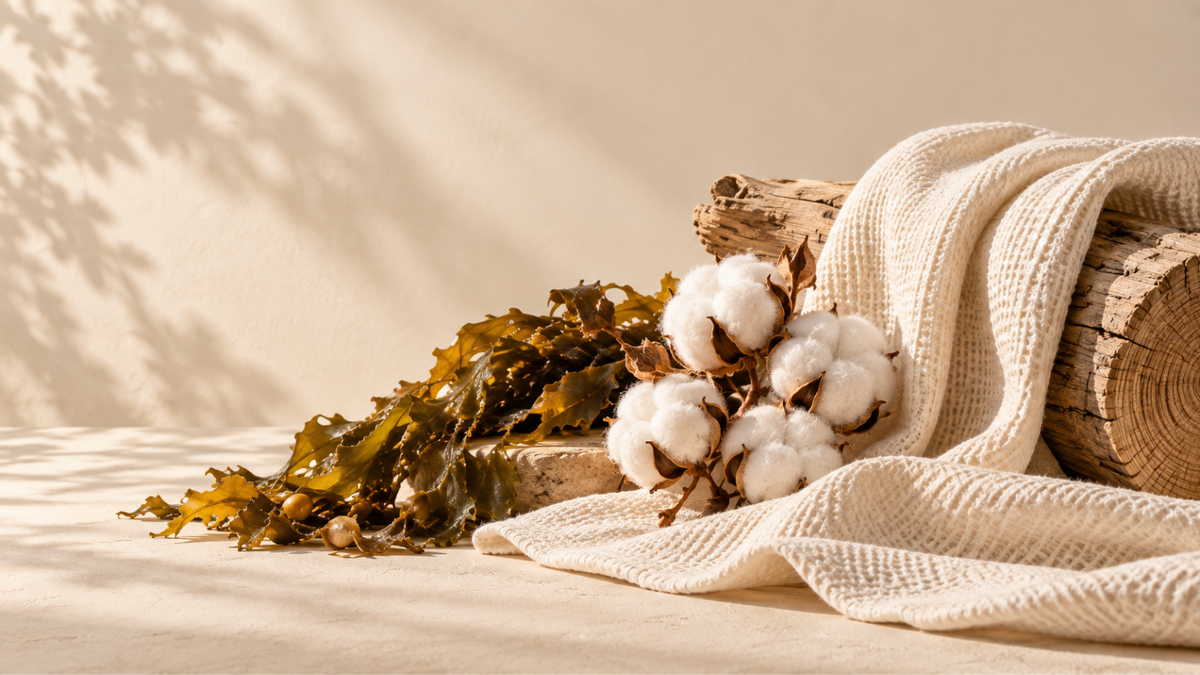
Cotton, seaweed and wood don't immediately sound like the beginning of the same product, and when we first started talking about bringing Good Earth Cotton™, SeaCell™ Lyocell and TENCEL™ Lyocell together, I understood why people wanted to know what one had to do with the other. One begins in Australian soil, another incorporates seaweed sourced from Icelandic waters into a cellulose-based fibre and the third begins with wood-derived cellulose, so on the surface they are three remarkably different beginnings; what interested me, however, was not their individual stories in isolation, but what could happen when we stopped looking for one perfect fibre and started thinking about how different materials could work together as a system.
This distinction has become increasingly important to the way we think about materials at SunGods, because there is a tendency within the sustainability conversation to search for a hero material, the one fibre, ingredient or innovation that can carry the environmental story of an entire product, when the reality of textile design is considerably more complex.
A beautiful fibre does not automatically make a beautiful fabric, just as an interesting material innovation does not automatically create a product that performs well, lasts or fits comfortably into everyday life.
What matters is what happens when the materials meet.

One of the earliest principles behind SunGods was that we wanted to understand what we were putting into our products before becoming distracted by what those products might eventually look like, because if we are going to ask people to think more carefully about the things they bring into their homes, we need to be prepared to do exactly the same thing while designing them.
That meant asking a different set of questions.
Where does the fibre begin, what role can it play within the textile, what happens when it is spun with another fibre, how does that yarn behave when woven into a particular construction, what changes when we alter the weight or finishing, how does the finished fabric perform when it is washed and used repeatedly and how do all of those decisions affect what may eventually be possible at the end of the product's useful life?
Those questions quickly moved us away from the idea that there would be one perfect material answer.
Instead, we began building a material architecture.
For our Founder Bath Sheet, that architecture is 54% Good Earth Cotton™, 21% SeaCell™ Lyocell and 25% TENCEL™ Lyocell, three fibres with very different origins brought together in a waffle construction that ultimately has to do something much more practical than tell a good materials story: it has to work as a bath sheet.
Cotton was always going to be part of the conversation, not because cotton is automatically good or bad, but because it is an extraordinary textile fibre that humans have been working with for thousands of years and one whose performance, familiarity and versatility have made it central to the products we use throughout our homes.
What matters is how that cotton is grown and how we understand its origin.
For the Founder Collection we chose Good Earth Cotton™, an Australian-grown cotton that became particularly interesting to us because it allowed the beginning of the material story to sit much closer to home while also connecting us with a farming system focused on regenerative agricultural practices.
There is something important about being able to trace a product back beyond a fabric mill or a spinner and remember that before cotton becomes yarn, fabric, bedding or a bath sheet, it is an agricultural crop.
It begins in soil.
That sounds obvious, yet I think we have become remarkably disconnected from the beginnings of many of the materials surrounding us, because by the time they reach our homes they have been transformed so completely that we rarely stop to think about where they came from.
For SunGods, understanding that beginning is part of understanding the product.

SeaCell™ was a very different discovery because the idea of seaweed having any relationship with a bath sheet or bed linen sounds unusual enough that it immediately attracts attention, which also means it is exactly the kind of material around which exaggerated claims can easily develop.
SeaCell™ is a cellulose-based fibre produced by Smartfiber in Germany, incorporating seaweed sourced from Icelandic waters into the fibre system, and that is already interesting enough without needing to turn it into something it isn't.
There are plenty of extraordinary claims made around materials, particularly when words such as natural, botanical, wellbeing or sustainable enter the conversation, and that isn't the SunGods philosophy; we don't need to add to the noise.
SeaCell™ is part of the material architecture of our Founder Collection because of the role it plays within the fibre system we are building, and we will talk about what we know, what can be substantiated and what we continue to learn, rather than turning an innovative material into a miracle claim.
For us, responsible design also means being responsible with the language we use to describe it.

The third part of the system is TENCEL™ Lyocell, a regenerated cellulose fibre made from wood-derived cellulose, and its inclusion takes us into another part of the textile world entirely because although its beginning is plant-based, the route from tree to finished fibre involves an engineered manufacturing process that transforms cellulose into a fibre suitable for textile production.
That distinction matters because words such as natural can become surprisingly imprecise once we start talking about modern textiles.
Cotton grows as a fibre on the plant. Lyocell does not.
Lyocell begins with cellulose and is manufactured into fibre, which is why I think it is more useful to explain what a material actually is than to force everything into simple categories of natural versus synthetic and assume one word tells us whether a textile is responsible.
Materials deserve more nuance than that.
TENCEL™ Lyocell became part of our fibre architecture because we were interested in what a regenerated cellulose fibre could contribute alongside cotton and SeaCell™, but again, its value to us isn't simply the fact that we can put an interesting fibre name on a label; it is what happens when it becomes part of the yarn and ultimately part of the finished textile.

This is where the story becomes less about three individual fibres and more about textile engineering, because the finished product isn't experienced as 54% of one thing, 21% of another and 25% of something else; you experience the fabric created when those materials have been spun, woven, finished and constructed together.
That is why fibre percentages, while important, never tell the whole story.
Change the yarn and the fabric changes.
Change the weave and the fabric changes.
Change the GSM and the fabric changes.
Change the finishing and the fabric changes.
Even with exactly the same fibre composition, two textiles can behave and feel remarkably different depending on what happens after those fibres arrive at the mill.
Our Founder Bath Sheet is a good example because the three-fibre system eventually became part of a 345 GSM waffle construction, and it was through the development of that construction that we started seeing how decisions made at fibre level interacted with decisions about weight, texture, drying, scale and everyday use.
This is why I increasingly think of materials as architecture rather than ingredients.
An ingredient list tells you what is there.
Architecture asks how everything works together.

There is another reason this way of thinking matters to SunGods, and that is because circularity cannot simply be added to a product after it has already been designed.
If we want products to have a beginning, a useful life and eventually a way home, then the material decisions made at the beginning have consequences for what may be possible later, which means circular design has to start long before anybody sees the finished bath sheet or sleeps in the finished bedding.
We are still at the beginning of understanding what that entire system can become, and I don't want to pretend that the Founder Collection represents a perfectly closed loop because it doesn't.
What it does represent is a deliberate attempt to make the beginning, life and eventual recovery of a product part of the same design conversation, rather than manufacturing something first and asking what to do with it at the end.
That difference matters.
Good Earth Cotton™, SeaCell™ Lyocell and TENCEL™ Lyocell — three remarkably different beginnings, brought together in one textile.
Yes, they give us an interesting story to tell, but that was never the reason for bringing them together. We chose these three fibres because we wanted to build a considered material system, understanding that no single fibre determines the performance of the finished product; what matters is how their individual properties work together through the yarn, the construction, fabric weight and finishing, and ultimately how all of those decisions translate into the way the product feels, performs and is used in everyday life.
Perhaps that is the more interesting materials story anyway, because nature rarely works through one extraordinary element acting alone; it works through systems, relationships and interdependence, where the behaviour of the whole is shaped by the way individual parts interact.
That is increasingly how I think about the products we are building at SunGods.
Not cotton versus seaweed versus wood.
Cotton, seaweed and wood.
Different beginnings, different roles and one material system, designed not simply for the moment somebody brings it home, but with consideration for the life that follows and, eventually, what comes next.
Designed with a beginning, a life and a way home.
Explore the materials in our fibre blend and learn how our circular returns programme gives them a way home.