
There have been moments over the last year when SunGods has existed almost entirely in my head, in drawings, spreadsheets, fibre specifications, samples, emails crossing time zones and conversations with people who understand spinning, weaving, regenerative cotton, cellulose fibres, seaweed, embroidery, plant-derived elastic and textile construction considerably better than I did when this journey began, and while I have shared much of that process as we have gone along, there is something quite different about reaching the point where all of those decisions finally become something you can see, touch and live with.
The first SunGods Founder Collection is here.
Bath sheets and bed linen may still be fundamentally ordinary products and I actually like that they are, because the ambition was never to invent something nobody had seen before; it was to take the things already sitting quietly inside our everyday routines and ask what might happen if we reconsidered their materials, construction, details, use and eventual return from the beginning rather than treating responsibility as something to add once the product had already been designed.
What has emerged isn't a perfect circular product, and I won't pretend that it is.
It is our beginning.
When I began developing SunGods, I wasn't really thinking about launching a coordinated homewares collection and I certainly wasn't sitting with a conventional product roadmap deciding which colours, categories or seasonal trends would give us the strongest first range.
The question was much more fundamental: could we design an everyday product with a beginning, a useful life and a way home?
That question led us backwards before it allowed us to move forwards, because instead of beginning with the finished product and working out how to manufacture it, we started looking at fibres, how they were grown or produced, how they might work together, how they would be spun and woven, what other components would eventually be needed and what those decisions might mean later in the product's life.
It was slower.
It was considerably more complicated.
It also changed what I thought product development was.
The bath sheet became an exploration of how Good Earth Cotton™, SeaCell™ Lyocell and TENCEL™ Lyocell could work together through yarn, waffle construction, weight and finishing, while the bedding pushed the same material thinking into a very different experience where weave, touch, construction and the simple ritual of making a bed became equally important.
The collection grew from those questions rather than the other way around.
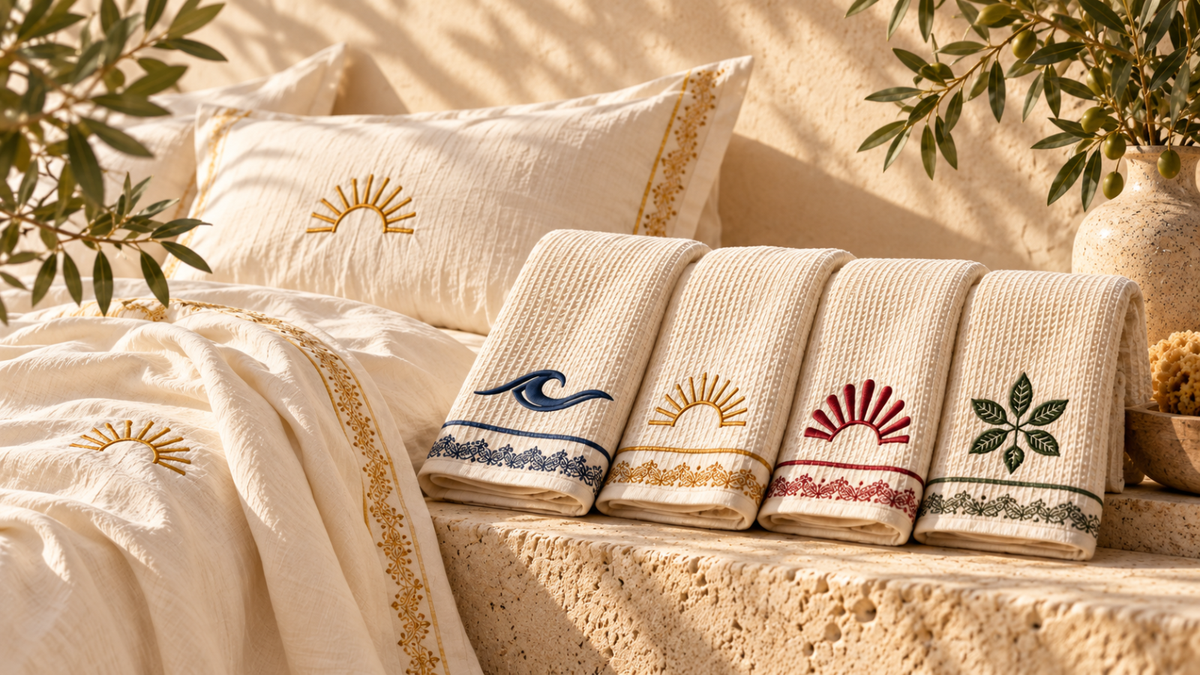
The Founder Collection is built around Pontus, Helios, Gaia and Demeter, and while each God has its own identity, colour and embroidery language, they are not four separate product philosophies; they are four ways into the same SunGods world.
Pontus; The Flow begins with the sea and the idea of movement, represented through the deep blue wave motif.
Helios; The Transformation draws on the sun, represented through gold and the repeated rising-sun embroidery that has become such a recognisable part of the first physical samples.
Gaia; The Beginning returns us to earth and origin, carried through its deep red motif.
Demeter; The Nourish speaks to growth and what sustains us, represented in green.
I didn't want the Gods to become decoration applied at the end of the design process; they needed to create an emotional layer within a collection whose underlying material and construction principles remain consistent, allowing somebody to choose the story they connect with without asking us to manufacture endless variations of essentially the same product.
That matters because choice and excess are not the same thing.
We can create identity without creating an enormous catalogue.

The bath sheet is where much of this journey first became physical, and if you have followed The Source over the last few weeks you will know that the finished specification is the result of considerably more questioning than I ever expected a towel to require.
The Founder Bath Sheet is 170 × 90 cm and approximately 345 GSM, woven in a waffle construction from 54% Good Earth Cotton™, 21% SeaCell™ Lyocell and 25% TENCEL™ Lyocell.
Those numbers describe the product, but they don't really explain it.
The explanation is in why we moved away from our original heavier sample, why we reconsidered the dimensions, why the waffle mattered and why we stopped assuming that more weight automatically meant more luxury, because once we started designing around the entire life of the bath sheet (using it, hanging it, washing it, drying it, folding it, storing it and using it again) the product needed to make sense beyond the moment it first arrived.
It needed to be lived with.
That has become one of the simplest tests we apply to SunGods design: does this decision make the product better to own, or does it simply make it easier to sell?
They are not always the same thing.
The bedding took the same philosophy somewhere different, because the experience we wanted to create wasn't based on choosing between percale and sateen but on questioning why you should necessarily have to.
We have been developing the collection around the different characteristics of those constructions and the way they can exist within the same bed, including reversible elements that allow the experience of the fabric to change rather than requiring another complete set of bed linen to create something different.
There are also details that will probably never become the headline of the collection but which, for me, say considerably more about how we approach design: markers that help you identify the top and centre of the bed, embroidery that creates a natural guide for the top-sheet turn-down, and a fitted-sheet retention system we have been developing using YULASTIC, with plant-derived elastic positioned beneath the mattress rather than simply accepting conventional elastic because that is how fitted sheets have always been made.
None of these things reinvents the bed. They aren't supposed to.
They simply ask whether something we do repeatedly can be made a little more intuitive, and whether the hidden components deserve the same scrutiny as the parts everybody sees.

The word Founder is deliberate. This isn't simply our first collection with a more interesting name attached to it; it represents the people willing to participate at the beginning, while the system is still being built and while we are still learning what works, what needs to change and what SunGods can ultimately become.
There will be 400 Founder Bath Sheets (100 for each God) and 400 Founder Bed Sets, and those numbers are intentionally small compared with the volumes conventional consumer brands are often designed to chase. We aren't trying to fill warehouses with speculative inventory. We want to make a defined first run, put those products into real homes and learn from what happens next.
How do people actually use them?
Which details matter once the product leaves our hands?
How do the materials behave over time?
What do people care about that we didn't anticipate?
And, eventually, what does the return pathway look like when these first products have completed their useful life?
A circular system cannot be proven by a diagram. At some point, products have to enter the world and the system has to begin operating around them.
The Founder Run is where that starts.

The Circle has always been about more than early access to SunGods products, because if the relationship ends at the transaction we haven't changed very much.
The product leaves us and enters somebody else's life, where it will be washed, used, cared for, perhaps repaired, hopefully kept for a long time and eventually reach a point where its first useful life is finished; what happens across that entire period matters if we are serious about circularity.
The Circle creates the relationship around that journey.
It gives us a way to share what we learn, help people care for what they own, experiment with better habits and eventually build the return pathway that brings SunGods products back rather than leaving somebody to work out what to do with them alone.
That is the system we are trying to prove.
Not that we can sell a towel.
That part has been done before.
The more interesting question is whether we can create a different relationship between the person who makes a product, the person who owns it and what happens when that product is no longer needed.

One of the easiest things to do at this point would be to present the Founder Collection as the finished answer, because launches encourage certainty; they ask brands to talk as though every problem has been solved and every decision was obvious from the beginning.
That isn't what happened here.
We have changed specifications, challenged assumptions, waited for materials, questioned components, reconsidered verification pathways, worked through manufacturing realities and learned repeatedly that designing for circularity is much easier to describe than it is to execute.
There are parts of the system we still need to prove.
There are things we will learn only when the products are being used.
There will almost certainly be decisions in future runs that are different because of what this first one teaches us.
I don't see that as a weakness in the Founder Collection.
I think it is precisely why a Founder Collection matters.
For months I have written about beginnings: Australian cotton growing in soil, seaweed from Icelandic waters, cellulose derived from wood, yarn being spun, fabrics being woven, samples being made and remade, and a circular system slowly taking shape around products that most of us barely think about.
Now those beginnings have become something physical.
A bath sheet you can wrap around yourself.
A bed you can climb into.
Four Gods you can choose between.
And 800 Founder products that will become the first real test of whether the ideas we have been building can move from design into everyday life.
There is still a long way to go, but I think there is something worth acknowledging about this particular moment because, after all the research, development, manufacturing conversations and changes, SunGods is no longer simply an idea about how products could be made differently.
It is becoming a product, a community and, slowly, a system.
The first SunGods Founder Collection is here.
And this is only the beginning.
Designed with a beginning, a life and a way home.
Explore our Founder Drop and learn how our circular returns programme gives your pieces a way home.