When we started developing the first SunGods collection, I genuinely thought the bath sheet would be one of the easier products. After all, towels already exist! There are thousands of them, every hotel and home has them and every retailer seems to have a version promising to be softer, thicker, fluffier, heavier or somehow more luxurious than the one sitting next to it.
How difficult could it possibly be?
Quite difficult, as it turns out, because the moment you stop asking how do we make a beautiful bath sheet and start asking how do we make a beautiful bath sheet differently, almost every assumption behind something apparently very simple becomes open to question.
What should it be made from? Where should those fibres begin? How should they be combined? What construction should we use? How large should it be? How heavy does it actually need to be? How should it feel against your skin, behave after repeated washing and fit into the reality of everyday life rather than simply look impressive folded on a shelf?
Then there was the question sitting behind almost every decision we were making at SunGods.
What happens next?
What happens to the product and the materials inside it, when its first useful life eventually comes to an end?
That was the point at which we stopped designing a towel and we started thinking about the entire system around it.

Most of us experience textiles backwards, we encounter the finished object first; the shirt, sheet, bath towel or pair of jeans while the agricultural, biological and manufacturing systems sitting behind it remain largely invisible. Yet every textile begins somewhere, and for our Founder Bath Sheet, that beginning became one of the most important design decisions we would make.
We wanted to explore whether fibres originating from very different natural systems could be brought together intentionally rather than simply selecting a conventional composition because that was how bath towels had always been made.
The composition developed for our Founder Bath Sheet is:
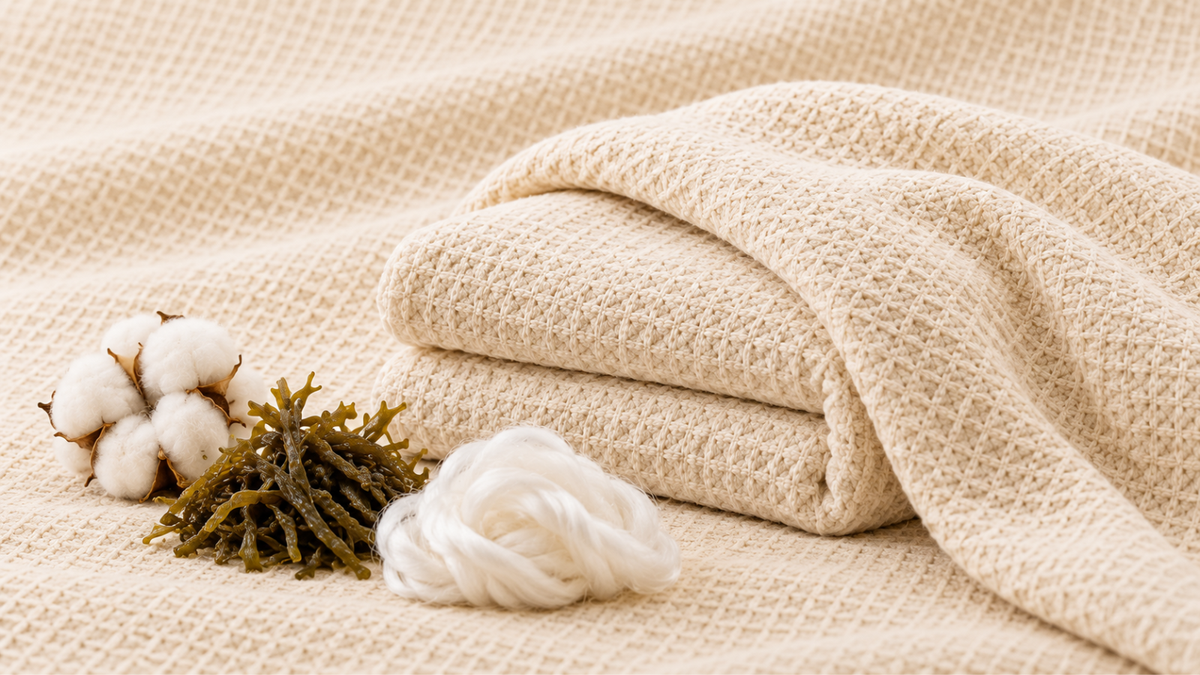
54% Good Earth Cotton™ 21% SeaCell™ Lyocell 25% TENCEL™ Lyocell
Good Earth Cotton, Seaweed and Wood-derived cellulose, three remarkably different beginnings brought together in one textile. Yes, they give us an interesting story to tell, but that was never the reason for bringing them together. We chose these three fibres because we wanted to build a considered material system, understanding that no single fibre determines the performance of the finished product. What matters is how their individual properties work together through the yarn, the waffle construction, fabric weight and finishing and ultimately how all of those decisions translate into the way the bath sheet feels, performs and is used in everyday life.
That became one of the most important lessons of the development process, you cannot design the fibre and ignore the fabric and you cannot design the fabric and ignore the yarn. You cannot design any of them without thinking about the person who eventually has to live with the product.
Good Earth Cotton™ gave us an Australian agricultural beginning and that mattered to me.
SunGods is an Australian company and, where it makes technical and commercial sense, I want our material system to remain connected to the landscapes and agricultural systems from which those materials originate rather than allowing the finished product to become completely disconnected from its beginning. Cotton also has a practical reason for being here. Its hydrophilic cellulose structure and moisture absorption characteristics are part of the reason cotton has remained so important in household textiles, particularly products such as towels where interaction with water is fundamental to what the product needs to do. We didn't want the cotton to work alone, we wanted to understand what could happen when it became part of a broader fibre system.
SeaCell™ was one of those materials I found almost difficult to believe when I first encountered it. A textile fibre incorporating seaweed! It sounded more like something from an experimental materials exhibition than something that could eventually become part of an everyday bath sheet. The seaweed used for SeaCell™ originates from Icelandic waters and becomes part of a cellulose-based fibre produced by Smartfiber in Germany. What interested us wasn't the novelty of being able to say our bath sheet contained seaweed. Novelty wears off remarkably quickly. What interested us was the opportunity to bring a marine-derived material into the fibre architecture and understand how it could work alongside cotton and TENCEL™ Lyocell within the construction we were developing.
There are plenty of extraordinary claims made around materials, particularly when words such as natural, botanical, wellbeing or sustainable enter the conversation. That isn't the SunGods philosophy, and we don't need to add to the noise. SeaCell™ is part of the material architecture of our Founder Bath Sheet because of the role it plays within the fibre system we are building. We will talk about what we know, what can be substantiated and what we continue to learn, rather than turning an innovative material into a miracle claim. For us, responsible design also means being responsible with the language we use to describe it.
The third component is TENCEL™ Lyocell, a regenerated cellulose fibre manufactured from wood-derived cellulose. Again, the important point for us was not simply the name of the fibre. It was how the fibres would behave together once they stopped being individual ingredients and became yarn and eventually, fabric. This is one of the things developing textiles has taught me to respect, there is rarely one hero, change the blend and you can change the behaviour, change the yarn and you can change it again, change the weave, density, finishing or weight and those same fibres can produce a completely different textile.
Which meant the next question wasn't simply what should our bath sheet be made from?
It was what should we do with those materials once we had chosen them?

There was another assumption I wanted to challenge that luxury automatically means fluffy. Walk into most premium bathroom departments and the visual language is remarkably consistent: large piles of thick terry towels, dense loops, high GSM numbers, more volume, more weight and inevitably, more material.
Somewhere along the way, weight itself appears to have become shorthand for quality but I kept coming back to a very practical question.
Why?
I live near the beach, I train daily, shower frequently and I wash towels frequently.
I want something generous enough to wrap around me, beautiful enough to leave hanging in the bathroom and comfortable enough to use every day, but I don't particularly want to wrestle an enormous wet piece of fabric into the washing machine and then wait half a lifetime for it to dry.
So we started looking differently at construction, the answer became waffle. Rather than creating the experience predominantly through a dense terry pile, waffle construction creates its distinctive texture through the structure of the fabric itself and this changed the design conversation completely.
Instead of asking how heavy can we make it? we started asking a much more useful question.
How much material does it actually need?

Our Founder Bath Sheet is approximately 345 GSM. For anyone who hasn't spent the last year talking to textile manufacturers, GSM simply means grams per square metre. It measures fabric mass, it is useful but it is not a universal measure of quality.
A higher GSM tells you that a square metre of one fabric weighs more than a square metre of another. It does not, on its own, tell you whether that fabric will give you a better experience, how the construction will behave, how it will handle moisture, how practical it will be to wash and dry or how it will perform after repeated use.
Fabric behaviour is considerably more complicated than one number. Research into textile moisture management and comfort repeatedly demonstrates the influence of variables including fibre composition, yarn structure, thickness, porosity and fabric construction on the behaviour of the finished textile. That doesn't mean lighter is automatically better either, it means design matters.
For us, 345 GSM became part of finding the balance we actually wanted rather than chasing the largest number we could put on a product page, substance without unnecessary bulk, texture without excessive weight and a bath sheet designed around the way we actually want to use it.
The final judgement, of course, won't come from a specification, it will come from living with it.
Originally, our thinking around the bath sheet was larger, again, because that is what luxury is supposed to mean, Bigger. After receiving the samples, we challenged that assumption as well.
The Founder Bath Sheet is now locked at 170 × 90 cm. Still generous enough to wrap around the body properly, take to the beach, throw around your shoulders while watching the surf or use after a shower, but considered rather than oversized simply for the sake of being able to call it oversized. This became one of those deceptively small product decisions that taught me something much bigger about building SunGods.
When you are designing from scratch, restraint can be harder than addition. It is remarkably easy to keep adding; more size, weight, features, packaging, claims and options.
The harder question is whether each addition genuinely makes the product or the experience better. If the answer is no, why are we adding it?

Of course, deciding what we wanted didn't mean we could simply make it, the fibres have to be sourced, become yarn, the yarn has to behave correctly through weaving, the waffle construction has to be developed, the natural fabric colour sampled, minimal natural non toxic dyes for embroidery, weight and dimensions need to be assessed and finishing needs to be considered. Wash performance, shrinkage and absorbency need to be tested. The product has to be cut and made, embroidery has to work with the construction rather than distort it, edges and seams have to survive repeated use and every time one variable changes, it has the potential to affect another.
This is the part of product development people rarely see, the beautiful finished photograph comes at the end.
Before it are specifications, swatches, samples travelling between countries, measurements, technical conversations,virtuals across time zones, manufacturing constraints, mistakes, compromises, corrections and an extraordinary number of decisions about things most people will never consciously notice.
This has actually become one of my favourite parts of building SunGods because once you understand how many decisions sit inside an apparently simple object, you never really look at that object in quite the same way again.
This is important, I don't want to describe the Founder Bath Sheet as perfect before people have lived with it. We have specifications, we know our materials, we have development samples and manufacturing expertise behind the product, we have testing requirements around wash performance, shrinkage and absorbency.
Development samples and technical specifications are not the same thing as hundreds of products living in hundreds of real homes.
How does it feel after the twentieth wash? How does the waffle settle over time? How does it work in different homes and different climates? What does somebody love about it that we didn't expect? What annoys them? What should we change?
Those questions matter because the Founder Run was never supposed to represent the end of product development, it gives us somewhere meaningful to begin.
We are making 400 Founder Bath Sheets.
100 Pontus.
100 Helios.
100 Gaia.
100 Demeter.
That number isn't an attempt to manufacture scarcity for the sake of exclusivity.
It is a deliberate beginning, large enough to create something real and small enough to stay close to what we learn. The first SunGods bath sheet isn't the conclusion of our work on bath sheets. It is the first physical expression of everything we have been learning about materials, manufacturing, thoughtful design and what responsible luxury might actually mean when you have to move beyond philosophy and turn those ideas into an object somebody uses every day.

After spending this long building one, I can say with absolute certainty that what appears to be a very simple product becomes considerably less simple when you follow it all the way back to its beginning.
There is agriculture behind it, fibre science, textile engineering, design, manufacturing, people, logistics, everyday behaviour and eventually, if we build the system properly, a pathway beyond its first life.
All wrapped into something you use after a shower, which is perhaps the point.
We talk about changing enormous systems as though change must always begin with enormous things, when sometimes the most interesting place to start is much closer to home, with the ordinary products we touch without thinking and the routines we repeat every day.
Sometimes it begins with asking why something has always been made a particular way, with choosing a different material, with making less and we decided to do this with a bath sheet.
This is ours. The first 400. The beginning of the SunGods Founder Run.
Designed with a beginning, a life and a way home.
Explore the materials behind our fibre blend, or discover our waffle bath sheets.
Explore the materials behind our fibre blend, or discover our waffle bath sheets.