
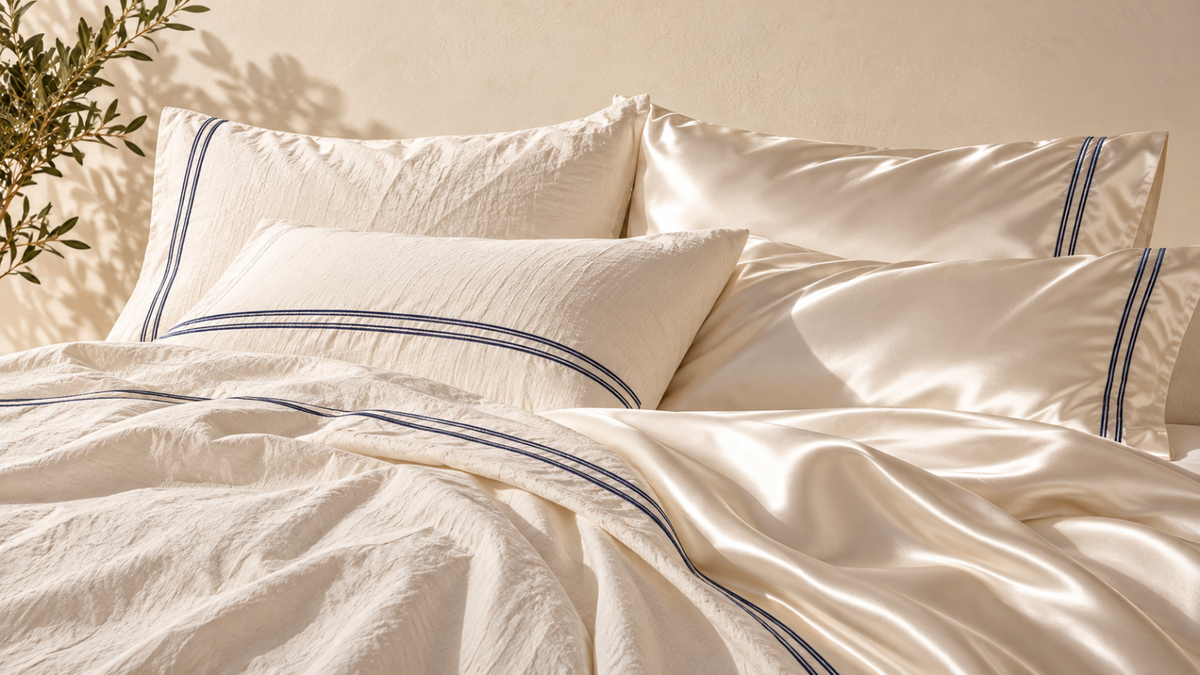
When we started developing the SunGods bedding, I found myself being presented with a choice that anyone who has spent time looking for good bed linen will probably recognise: percale or sateen, crisp or smooth, matte or lustrous, one experience or the other, and while there are very good technical reasons these two constructions feel different, I kept coming back to a much simpler question, which was why, when both have something genuinely different to offer, we had accepted that we necessarily needed to choose between them.
I didn't want to create two complete bedding collections simply so somebody could experience two different fabrics, because that would have meant more products, more inventory, more decisions and ultimately more things being manufactured, when perhaps the more interesting design challenge was whether we could bring those experiences together.
That question became the beginning of the SunGods Founder Bed Collection.
Not percale or sateen.
But percale and sateen.

Percale and sateen are sometimes discussed as though they are different materials, when they are actually different ways of constructing fabric, and that distinction matters because the weave influences how the finished textile looks, feels and behaves even when the fibres themselves may be similar.
Percale traditionally uses a simple one-over, one-under weave structure, creating a balanced surface that is generally associated with a crisp, matte hand, while sateen uses a different interlacing structure with longer yarn floats across the surface, creating the smoother hand and subtle lustre people tend to associate with sateen bedding.
The difference is something you can feel.
One has that clean, fresh quality people often describe when they talk about a beautifully made hotel bed; the other feels smoother, softer and more fluid against the skin, and neither experience is inherently more luxurious than the other because they are simply creating luxury in different ways.
Once I understood that, choosing one began to feel less interesting than asking how we could design with both.

There is a tendency in bedding to reduce quality to numbers, particularly thread count, where bigger numbers have become so closely associated with better sheets that the specification itself can end up doing more marketing work than the fabric.
We didn't want to design that way.
Our Founder bedding has been developed around a 200 thread count percale and a 295 thread count sateen, but those numbers are specifications rather than the reason the fabrics exist, because what matters to me is how the construction, fibre system, weight and finishing come together once somebody actually gets into bed.
The percale we have been developing is approximately 120 GSM, made from 55% Good Earth Cotton™, 25% TENCEL™ Lyocell and 20% SeaCell™ Lyocell, while the sateen is approximately 137 GSM, made from 60% Good Earth Cotton™, 22% TENCEL™ Lyocell and 18% SeaCell™ Lyocell.
They are related, but they aren't identical.
a that was intentional.
We weren't trying to force exactly the same material formula into two different constructions simply for the neatness of the specification; we wanted each fabric to work as part of the experience it was being asked to create.

This is where the design became more interesting, because a bed isn't a static object even though we often design bedding as though it is.
The way you want your bed to feel can change.
The weather changes.
The seasons change.
The way your body feels changes.
Sometimes you want crispness and structure; sometimes you want something smoother and softer, and there is no particular reason those preferences need to require two completely separate sets of bed linen sitting in a cupboard.
So we began exploring reversible construction for the parts of the bed where having those two experiences made the most sense.
The duvet cover and pillowcases are reversible, allowing percale and sateen to exist within the same product, while the fitted and flat sheets use percale where its particular character makes sense within the broader bed system.
That gives you the ability to change the tactile experience of the bed without changing the entire bed.
It is a small idea.
But small ideas can change routines.

One of the risks with adding functionality to a product is that the feature becomes something you have to think about every time you use it, which rather defeats the point if the objective is to make everyday life easier.
I didn't want the reversible construction to become a trick.
And it needed to feel obvious.
Turn it one way and experience one surface; turn it the other and experience another, while the visual language of the embroidery and construction still makes the bed feel like one coherent SunGods product rather than two fabrics stitched together for the sake of having another feature to talk about.
That same principle runs through the other details we have been developing for the collection: the God emblem helping you identify the centre, the SunGods marker helping orient the fitted sheet, the embroidery helping guide the top-sheet turn-down and the YULASTIC retention system sitting beneath the mattress.
None of those details asks you to learn a new way of making a bed.
They simply try to remove some of the unnecessary thinking from something you already do.

There is another reason I like the reversible idea, and it comes back to something we have been questioning throughout the Founder Collection: whether giving people more options necessarily creates a better product.
Walk into the bedding section of almost any large retailer and you can be confronted with an extraordinary number of colours, fibres, thread counts, finishes, collections and seasonal variations, which creates the appearance of enormous choice but also requires manufacturers to produce, forecast, warehouse and eventually clear an equally enormous number of products.
We aren't trying to build SunGods that way.
The Founder Collection is deliberately restrained because I would rather put more thought into fewer products and give those products the ability to work harder within somebody's home.
Reversibility is one expression of that philosophy.
Rather than asking you to buy one set because you like percale and another because you like sateen, we asked whether one product could give you access to both.
That doesn't eliminate consumption.
It does question whether every new experience needs another object.

I have written previously about how building SunGods has changed my own understanding of luxury, and the bedding has probably pushed that thinking further than anything else we have developed because the traditional signals of luxury bed linen are so established: high thread counts, large ranges, pristine styling and language designed to make one fabric sound objectively superior to another.
I increasingly think luxury is more personal than that.
It is the bed feeling right when you climb into it.
The fabric that feels considered against your skin.
It is the details that make sense without demanding attention.
It is being able to change the experience because you feel like something different tonight, rather than because somebody has told you one construction is the correct definition of premium.
And it is knowing the choices behind the product extend beyond the visible surface.
That is the kind of luxury I am interested in building.
Not more for the sake of more.
But more thought inside what is already there.
Perhaps the biggest lesson from developing the Founder bedding is that it is very easy to design individual products and much harder to design the experience those products create together, because a fitted sheet, flat sheet, pillowcase and duvet cover may each have their own specifications, but nobody experiences them as four technical documents.
You experience a bed to sleep in.
That means the fibres have to work with the weave, the weave has to work with the construction, the construction has to work with the embroidery and markers, and all of those decisions have to disappear into a routine that ultimately feels simple.
That is what we have been trying to build.
Percale and sateen are part of that system, not because we wanted another feature to add to the Founder Collection, but because they gave us two genuinely different textile experiences and created an opportunity to ask whether thoughtful design could bring them together rather than forcing somebody to choose.

There will always be people who prefer percale and people who prefer sateen, and there is nothing wrong with choosing one and loving it.
We simply wondered whether choosing had to be the only answer.
By bringing the two constructions together within the Founder Collection, we can allow the bed to change without requiring an entirely different collection to create that change, while still keeping the material architecture, visual language and design philosophy connected.
It is another small example of the question sitting underneath almost everything we are building at SunGods: how can the things we already live with do more, make more sense and ask us to consume a little more thoughtfully?
Sometimes the answer is found in a completely new material or manufacturing process.
Such as underneath the mattress.
Or perhaps as simple as turning something over.
One bed. Two experiences.
Designed with a beginning, a life and a way home.
Explore the materials behind our bed linen, or discover the bedding in our Founder Drop.