
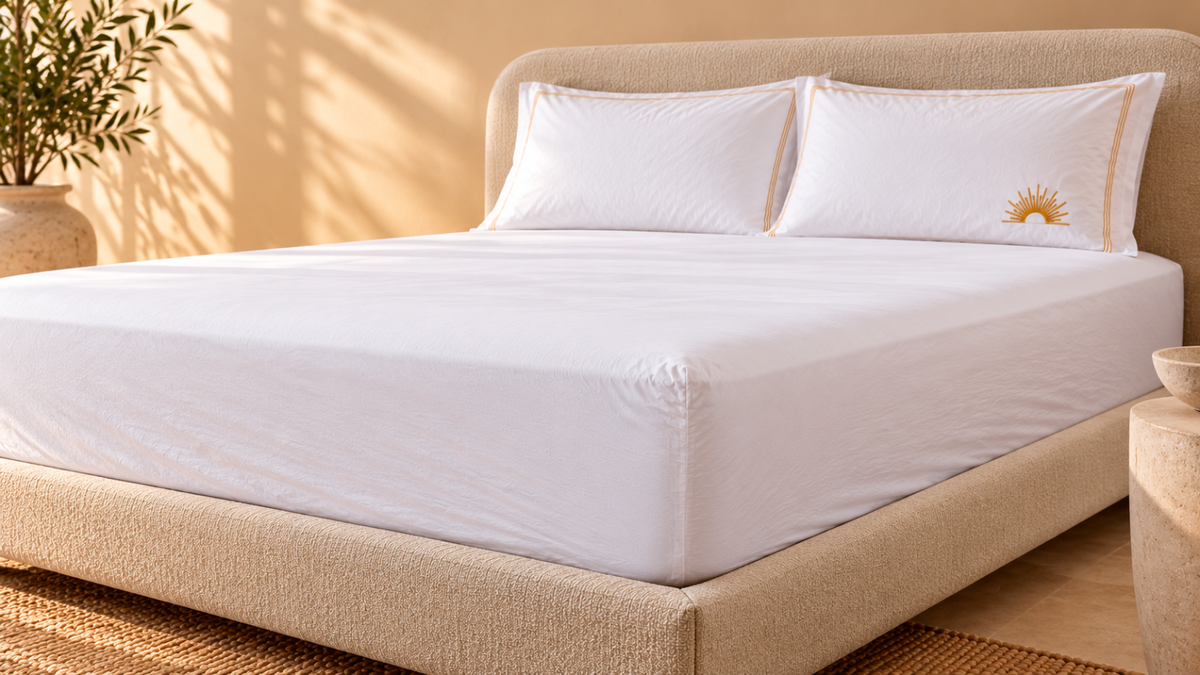
There are some products we use so routinely that we stop questioning why they work the way they do, and the fitted sheet is a very good example because, despite mattresses changing enormously in depth, construction and materials over the years, the basic solution for keeping a sheet attached to one has remained largely the same: fabric is shaped around the corners, conventional elastic creates tension around the edge and, if everything works as intended, the sheet stays where it is supposed to stay, except far too often it doesn't.
Corners work their way off, identifying the top of the sheet becomes an unnecessarily irritating exercise, deeper mattresses leave less fabric to secure underneath and making a larger bed can involve considerably more stretching, pulling and walking from one side to the other than something this ordinary should reasonably require.
None of these is a significant problem in the context of the world, but that is precisely why I find it interesting, because thoughtful design doesn't always begin with solving something enormous; sometimes it begins by questioning something everybody has stopped noticing and asking whether the way we have always done it is actually the best way to keep doing it.
Which is how we ended up redesigning the fitted sheet.

When we began looking at the material architecture of SunGods bedding, there was an obvious contradiction sitting around the edge of the fitted sheet: we could spend enormous amounts of time considering the fibres within the fabric and what might eventually happen to those materials, but if we simply added conventional synthetic elastic because that was the established way to construct a fitted sheet, we wouldn't really have challenged the whole product or remained true to our ambition to eliminate conventional plastics wherever technically possible.
It's the components you don't see that often matter most, because they are remarkably easy to overlook during product development; they rarely appear in photographs, seldom influence a purchasing decision and most of us probably never think about what the elastic inside a fitted sheet is actually made from until somebody asks the question.
We asked it, and after six months of research found YULASTIC, a plant-derived elastic alternative to conventional synthetic elastic, which initially appeared to answer our materials question but ultimately opened up a much more interesting design challenge: if we were changing the material, why simply replicate the conventional construction rather than reconsider how the entire retention system worked?

Once you strip away the familiarity of the product, a fitted sheet is essentially solving a mechanical problem: fabric needs to wrap around a three-dimensional mattress, accommodate variations in depth and movement, remain sufficiently tensioned to keep the sleeping surface smooth and, importantly, stay attached while somebody sleeps on it.
The conventional approach distributes elastic tension around the perimeter, whereas we started exploring whether that tension could be positioned more deliberately, developing a system using vertical stretch at the corner, a horizontal return and a diagonal retention strap positioned beneath the mattress, creating different points of tension that work together rather than relying entirely on one continuous elasticated edge.
The under-mattress component is particularly important because it changes where the retention force acts, helping anchor the corner from underneath while keeping the mechanism largely invisible once the bed is made, and that is exactly how I want thoughtful design to work: the intelligence should sit inside the product rather than becoming another feature somebody has to understand.
If the system performs as intended, making the bed should require considerably less wrestling with corners and fabric, not more instructions.
Part of the challenge is that there isn't really one standard mattress anymore, because mattresses vary considerably in depth and construction, and once toppers, protectors and other layers are added, the amount of fabric a fitted sheet needs to accommodate can change again.
Our design target has been to accommodate mattress pockets of up to approximately 43 centimetres, while maintaining sufficient fabric return beneath the mattress for the corner retention system to work as intended, which has influenced everything from the positioning and width of the YULASTIC components to the geometry of the corner itself.
This is one of the recurring lessons from building SunGods: the products we consider simplest are often simple only because somebody else has already solved an enormous number of problems before we encounter them, and once you decide to challenge one of those solutions, you inherit those problems again.

Of course, something making sense on paper doesn't mean it will automatically perform as intended, and the fitted-sheet system has required us to work through different corner configurations, YULASTIC widths, positioning and retention approaches before moving towards the finished construction.
The next test is how those decisions perform in real life, including whether the strap creates sufficient retention, whether the corners remain secure through normal movement, how easily the sheet fits different mattress depths and how the YULASTIC behaves through repeated use and laundering.
This is also where our Founder Run becomes particularly valuable, because our first customers will be able to use the system in their own homes and provide honest feedback about what works, what doesn't and what we should improve.
I don't want to present the system as perfected before we have that experience, because product development isn't a straight line between an idea and a finished product; it is a series of assumptions that have to survive contact with the physical world, and some will prove correct while others will need refining.
That is how the design gets better.
There is a broader circular-design principle sitting underneath this development, because it would be relatively easy for us to talk about Good Earth Cotton™, SeaCell™ Lyocell and TENCEL™ Lyocell and allow those fibres to carry the entire responsibility story of our bedding, when the reality is that products also contain thread, embroidery, closures, structural components and packaging, all of which become part of whatever recovery system we eventually build.
Changing one component doesn't create a perfectly circular fitted sheet, but it does force us to consider the entire product rather than stopping at the materials that are easiest to talk about, and in this case that question led us into six months of research and an entirely new approach to corner construction.
That is the reality of trying to design differently; sometimes the solution is straightforward, sometimes it requires compromise and sometimes it sends you down a development path you never anticipated.

Even the most considered retention system becomes poor design if it makes putting the sheet on the bed more complicated, which is why our YULASTIC system sits alongside the other small details we have been developing across the Founder bedding, including the SunGods marker identifying the top of the fitted sheet and the God emblem helping locate the centre.
Together, these details are intended to remove some of the unnecessary friction from a routine most of us repeat throughout our lives: find the top, locate the middle, fit the corners, secure the sheet and make the bed, without needing to stop and work out which way everything goes.
The product shouldn't need to announce how clever it is while you are using it.
It should simply make sense.
We didn't begin this process because I woke up one morning determined to reinvent the fitted sheet, and I certainly don't believe innovation for the sake of being different is particularly useful.
We began because we questioned the conventional elastic sitting inside a product whose entire material system we were trying to reconsider, and once we asked that question, it became difficult not to ask the next one: if we are changing the material, should we also reconsider how the sheet is held in place?
That question led to YULASTIC, which led to new corner configurations, an under-mattress retention system, prototypes, measurements and another series of things we still need to prove, and somewhere along the way an ordinary fitted sheet became one of the more technically interesting parts of the Founder Collection.
Perhaps that is what thoughtful design looks like most of the time, not inventing things nobody has ever seen before, but being willing to question the things everybody already uses and ask whether there is a better way to make them.
Designed with a beginning, a life and a way home.
Explore the materials behind our fitted sheets, or discover the bedding in our Founder Drop.