For a long time, I assumed creating a luxury product worked something like this. You have an idea, choose a fabric, select a colour and create a design. A few weeks later, products arrive.
Simple. Or at least that's what I thought.
Then we started building SunGods and discovered just how little we understood about textile manufacturing.
What I learnt quickly, long before a towel hangs in a bathroom or a fitted sheet finds its way onto a bed, thousands of decisions have already been made, decisions most consumers never see and, until recently, neither did I.

The Awakening phase of this journey was about asking questions.
What are products actually made from?
Why is plastic hiding in so many places?
How did luxury become disconnected from nature?
Discovery began when we started looking for answers.
What started as curiosity quickly became ten months of research that led us into an entirely different world; Material innovators, fibre scientists, spinners, weavers, textile engineers, Product developers, sampling teams, mills and manufacturers spanning multiple countries and suddenly, products looked very different.
What once appeared simple now looked remarkably complex.
Before SunGods, I assumed products came from factories.
Today, I see them differently.
Products come from systems, relationships, landscapes, knowledge and thousands of decisions made long before they become part of our lives.

One of the biggest surprises was learning fabric isn't actually where the process begins.
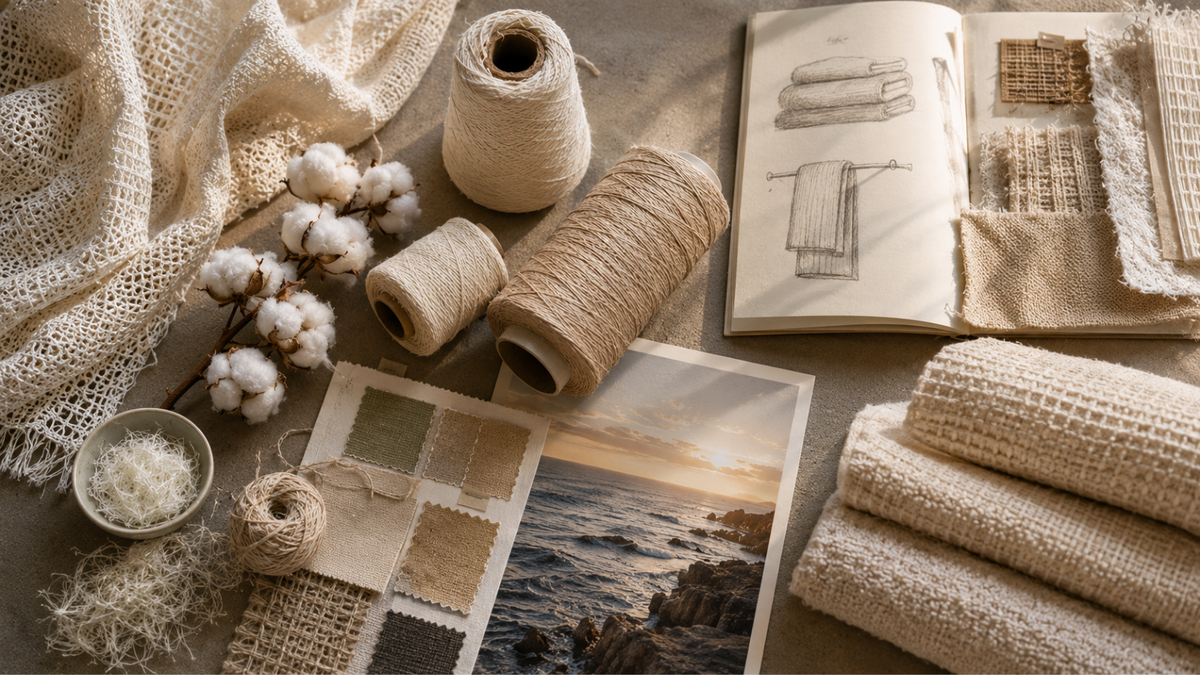
For SunGods, it begins with fibres.
Before fabric can be woven, yarn must be spun. Before yarn can be spun, fibres must be sourced. Before fibres can be sourced, crops must be grown, harvested and processed. Every stage influences the next.
What fascinated me most was discovering fibres have their own stories, technologies and supply chains. Here are the stories we unpacked for our lead fibres!
Good Earth Cotton™ begins its journey in Australia through regenerative agriculture and generations of farming expertise. SeaCell™ follows a specialised production pathway in Germany where sustainably harvested Icelandic seaweed is combined with wood-based cellulose to create an entirely new fibre. TENCEL™ follows its own advanced closed-loop manufacturing system with strict standards governing sourcing, production and fibre integrity.
These aren't simply materials selected from a catalogue at the cheapest price. They are entire ecosystems built around decades of innovation, expertise and relationships.
A decision made at the very beginning can still influence how a product performs years later.

Every founder has a moment where reality arrives. For me, it was minimum order quantities or MOQs. Three letters capable of destroying even the most ambitious spreadsheet.
Like many start-ups, I imagined we would be able to order exactly what we needed, a few hundred metres here and units there, start small, get feedback, iterate and grow, the textile industry plays by their rules.
The moment we decided to create our Founder Collection using a blend of Good Earth Cotton™, SeaCell™ and TENCEL™, we quickly discovered innovation comes with complexity.
Good Earth Cotton must be sourced and procured through approved supply channels with only two order dates each year, often beginning with minimum orders measured in tonnes rather than kilograms. SeaCell must be manufactured through recognised partners to maintain certification and traceability requirements. TENCEL follows its own specialised production pathway before it can even enter the textile supply chain.
What appeared to be a simple decision about materials suddenly involved farmers, fibre innovators, certification and traceability frameworks, spinning mills and manufacturers spread across multiple countries and that was before a single metre of fabric had been produced.
Then comes spinning. Even if you can keep the MOQ low for your fibres, Spinning and weaving mills require minimum volumes as do manufacturers. What looks like a simple bath sheet or bed linen bundle often begins with commitments measured in tonnes rather than pieces. Suddenly, product development wasn't just about design, it became a lesson in economics, logistics and scale.

Another surprise? Sampling.
Most people imagine a sample as a finished product, in reality, samples are questions.
Sometimes they are questions nobody has asked before.
Throughout this journey we discovered creating something different often means there isn't an existing blueprint to follow. Before we can create our final fabrics, we must continually test, learn and refine construction methods as we better understand how natural fibres perform together.
Then the questions begin.
Can this yarn perform? Can this weave work? Is 450 GSM the right weight for our bath sheet? Is the natural colour more beautiful than its naturally dyed alternative? Can the finishing rinses be non-toxic, natural with no harsh chemicals? How does the fabric behave after washing? What happens after repeated use?
Even our embroidery became a series of questions. Originally, we explored woven borders and more complex constructions before discovering restraint creates something far more beautiful.
Every sample answers one question while often creating three new ones.
This is why development timelines stretch into months rather than weeks. We have been speaking with our production partners almost daily since December last year, our teams are not moving slowly, they are ensuring every stage is designed to reduce risk before production begins.

The irony here is the products we are creating for our Founder Collection are incredibly simple, oversized bath sheets, reversible pillowcases and duvet covers, flat sheets and fitted sheets without conventional elastic.
These are products most of us use every day without thinking, yet behind every one of them sits an astonishing amount of expertise; Agriculture, fibre science, spinning, weaving, finishing, embroidery, product construction, quality control and logistics.
It's easy to overlook because when everything works well, the complexity disappears and that's exactly my point.

As we unpack manufacturing, my respect has grown for the people who build things from the ground up. Not just the designers and brands, but the growers, scientists, fibre innovators, technicians, spinners, weavers, makers and specialists whose knowledge rarely appears on a product label.
Building SunGods has reminded me every product has a story and most of the story happens long before it reaches our homes. Perhaps that's been the biggest discovery of all, we didn't set out to create towels and bedding, we set out to ask whether everyday products could be designed differently, products that honour where they came from, how they are made and what happens when their first life is over. I wanted to create a brand where responsibility can be beautiful. I haven't found all the answers, but I am willing to keep asking better questions and remain curious about where they might lead.
The products are only the beginning.
