
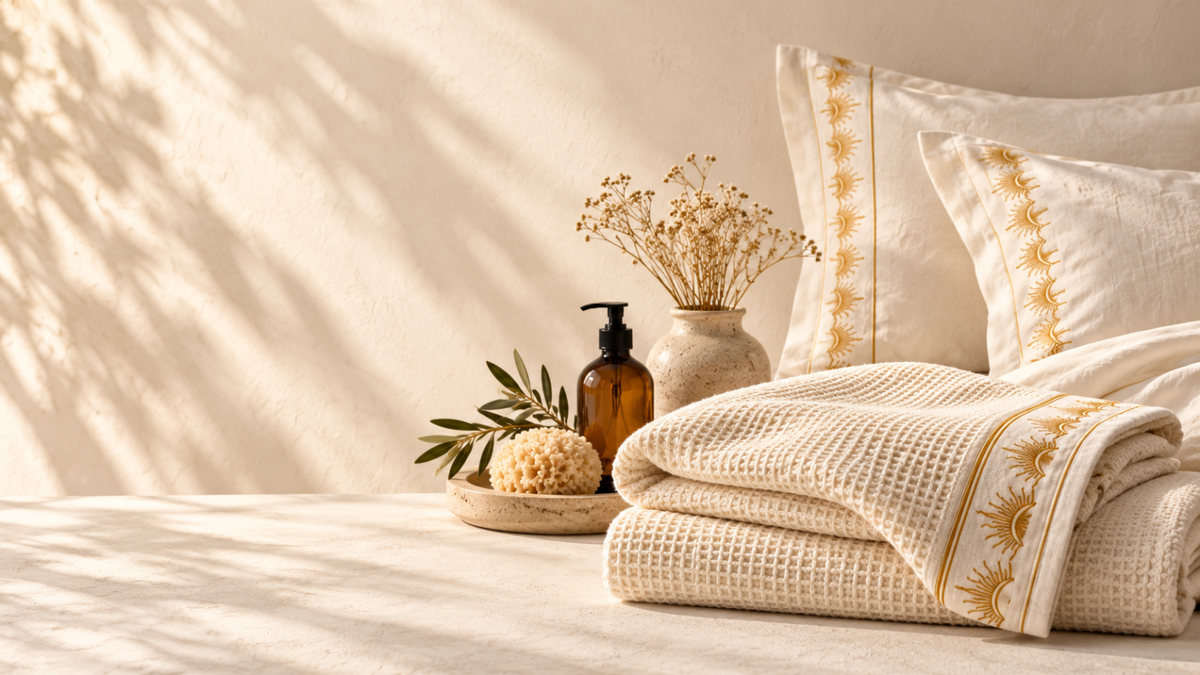

When I first started talking about SunGods, I was frequently asked why, if I was trying to rethink the way products are designed, used and ultimately recovered, I would start with fundamentally boring products such as bath sheets and bedding. Why not something more obviously innovative, something technological, something people would immediately recognise as a solution? My answer is actually quite simple: these are the things we live with, not occasionally but every day, and they are already part of the rituals that help us set the day up for success and, at the other end, relax and unwind at night. You wake up in your sheets, you make your bed, you shower, you reach for a bath sheet, and then you wash them, dry them, fold them, put them away and use them again.
They sit quietly in the background of our lives, which is precisely why I think they are interesting, because if we want to change the way we consume, perhaps we don't need to begin by asking people to completely change the way they live; perhaps we begin with the things they are already using.
There is something about sustainability that has become unnecessarily overwhelming, because we are constantly being told to change our diet, our car, the way we travel, the energy we use, what we buy and how much we buy, while at the same time being expected to understand carbon, plastics, fibres, certifications, recycling systems and increasingly complex supply chains, and somehow work out which of the hundreds of environmental claims appearing on products are meaningful and which are simply very good marketing.
It is hardly surprising that people switch off.
Research into pro-environmental behaviour has demonstrated intention alone does not necessarily translate into action, because what we actually do is influenced by habit, convenience, context, social norms, perceived control and the systems around us, which means that simply asking people to care more is unlikely to be enough if the choices surrounding them remain difficult, confusing or inconvenient.
That distinction became increasingly important as I started thinking about what SunGods could become, because I don't want responsible living to feel like another job or another impossible standard we are all supposed to achieve. I am far more interested in whether we can make better choices easier to incorporate into the life somebody is already living, and whether thoughtful design can quietly remove some of the friction that prevents those choices becoming everyday habits.
Which brings us back to the bathroom and the bedroom.
We tend to remember the big decisions in our lives (moving house, changing jobs, getting married, having children, starting a business) yet the reality is most of our lives aren't made up of big decisions at all; they are made up of hundreds of small things we do repeatedly, often without consciously deciding to do them.
Behavioural research describes habits as responses which become associated with recurring contexts through repetition, which means once a behaviour becomes established it requires less deliberate thought and the context itself begins to prompt the action. This is why routines are so powerful and why seemingly insignificant behaviours, repeated over weeks, years and eventually decades, become such a substantial part of how we live.
Making the bed is a routine, showering is a routine, putting on the washing is a routine, getting ready for work is a routine and going to sleep is a routine and none of these things feels particularly significant on its own, yet collectively they form the architecture of everyday life.
This is where conscious living becomes much more interesting to me, because rather than treating it as a series of grand gestures or sacrifices, we can start looking at the ordinary routines we repeat every day and ask whether the products and systems surrounding those routines could be designed differently.
Not perfectly, but more thoughtfully.

Think about the life of a bath sheet for a moment: you buy it, use it, wash it, dry it and use it again, hundreds of times and throughout that life it interacts with your skin, water use, washing machine, laundry detergent, energy use, the space in your linen cupboard and eventually, when you decide it has reached the end of its useful life, whatever waste or recovery system is available to you.
Suddenly the humble bath sheet isn't quite so humble, because it sits at an interesting intersection between materials, product design and human behaviour and that is exactly where I wanted SunGods to begin.
I wasn't interested in creating an object that spends most of its life sitting untouched on a shelf; I wanted to work with products that have a genuine relationship with the person who owns them, products that are used, washed, dried, folded, lived with and eventually worn out, because if we are serious about designing products with a beginning, a life and a way home, then understanding that entire life matters.
There is another practical reason we started here, which is that when you use something frequently the consequences of design decisions become visible very quickly. Weight matters, drying matters, size matters, texture matters, durability matters, the amount of room something takes up in the washing machine matters, and the way it feels after repeated laundering matters, because you cannot hide poor design behind a beautiful photograph for very long when somebody is actually using the product every morning.
I like that accountability.
The bedroom is perhaps even more interesting because of the sheer amount of our lives we spend there and while sleep itself is fundamental to human health and functioning, I don't want to turn our bed linen into another exaggerated wellness story or suggest that a sheet is somehow going to magically fix your sleep.
What bed linen can do is become part of the environment and ritual surrounding sleep: the way the fabric feels when you get into bed, the satisfaction of changing the sheets, the feeling of a properly made bed at the end of a long day, and the small signals we create for ourselves as we move from activity into rest.
This is where thoughtful design and conscious living begin to overlap for me, because a product can perform a very practical function while also helping shape a routine, and if we are going to touch and live with that product every day, I think we should ask more of its design than whether it looks beautiful or matches the bedroom.
We should ask how it feels, how it performs, how it is made, whether the details make sense, whether we can keep it in use for longer and, importantly, what happens to it when we no longer can.

One of the things we have been thinking about throughout the development of the SunGods bedding collection is friction (not fabric friction, but human friction) those tiny annoyances built into ordinary routines that we have simply accepted because they seem too insignificant for anybody to redesign.
Which end of the fitted sheet is the top, where is the middle of the bed, why does the corner keep coming off, how far should I turn the top sheet down and why does making a large bed sometimes feel like a wrestling match? And don’t get me started on trying to lift my heavy duty mattress with two very weak shoulders!
None of these are world-changing problems and that is precisely the point, because thoughtful design does not always need to solve enormous problems; sometimes it simply needs to make something you already do repeatedly a little more intuitive.
Our bedding has been developed with small visual cues to help remove some of that guesswork: the SunGods marker identifies the top of the mattress, the God emblem helps locate the centre and the embroidery on the top sheet creates a natural guide for the turn-down, while our fitted-sheet development has challenged another convention entirely by asking whether we need to rely on conventional elastic in the way fitted sheets traditionally do.
Instead, we have been developing a retention system using YULASTIC, a plant-derived elastic material, with the retention strap sitting beneath the mattress to help hold the sheet in place, because if we are serious about reconsidering the materials used in a product, we also have to look at the components people rarely see rather than concentrating only on the parts that make a good photograph.
None of these details exists because a sheet needs more features. They exist because we looked at the ritual of making a bed and asked where thoughtful design could make that ritual easier.
This is also why The Circle matters so much to what we are building, because if SunGods simply makes products from more considered materials, sells them and then disappears until somebody is ready to buy another one, we haven't really changed the relationship between the person, the product and the system; we have simply changed the product.
The ambition behind The Circle is broader than that. It is about conscious living, learning together, changing small habits, understanding the things we bring into our homes, caring for them properly and keeping them in use, while ultimately creating a clear pathway for SunGods products when their first life with you comes to an end.
Circularity cannot exist solely at the point of manufacture, because what happens during the life of a product and what happens when somebody no longer wants or can use it are fundamental parts of the system. That means the person who owns a SunGods product isn't sitting outside that system as a passive consumer; they are part of it.
For me, that is one of the most important shifts we can make.
Perfection has become another problem within the sustainability conversation, because when every decision appears to require an understanding of which fibre, which certification, which packaging, which company and which environmental claim is technically the best, people understandably become paralysed or decide that the whole thing is simply too difficult.
I don't think conscious living should become a competition to see who can consume the least, understand the most or make every decision perfectly. For me, it is about becoming more aware of the relationship between the choices we make and the systems those choices support, and gradually asking better questions about the things we bring into our lives: do I need it, will I actually use it, what is it made from, can I care for it properly, can I keep it for longer and, when I am finished with it, what happens next?
Those questions don't demand perfection, but they do demand attention, and over time attention has the potential to change behaviour in a way that guilt rarely does.

That brings me back to why SunGods started here, with a bath sheet, a fitted sheet, a flat sheet, a duvet cover and a pillowcase, fundamentally ordinary things that most of us already own, use constantly and will probably buy again at some point in our lives.
Perhaps ordinary things are exactly where a different system should begin, because changing the way we live doesn't necessarily require us to abandon the rituals we already have; sometimes it means looking more carefully at those rituals, understanding the products sitting inside them, designing those products with greater intention, using them well, caring for them and ultimately creating a way for them to move into whatever comes next.
That, ultimately, is what I want conscious living to become: not another set of rules hanging over us, not an identity we have to perform and certainly not a pursuit of perfection, but a way of living where better decisions become increasingly natural because the products, routines and systems around us have been designed to help make those decisions possible.
That is why we started with the things you touch every day, because they are already part of your life and if we can begin changing the system around something as ordinary as a bath sheet or a bed, perhaps changing the way we live doesn't have to feel quite so extraordinary.
Designed with a beginning, a life and a way home.