

Ask someone if they are trying to reduce plastic, most will tell you they carry a reusable water bottle, avoid plastic bags, recycle, choose glass where they can but very few of us have looked at the products sitting quietly inside our homes.
The products we sleep on, wrap ourselves in, rest our heads on and workout in. The exact products which are marketed as natural, sustainable, luxurious and healthy because while we have become good at spotting obvious plastic, most of us have never been taught to recognise invisible plastic and once you start looking, you realise it is everywhere and not just in packaging but in the products themselves.

This blog started as a simple question. Could we create a better bath sheet? A simple enough challenge or so we thought. The deeper we went into textile manufacturing, the more uncomfortable the answers became. Every solution seemed to involve petroleum.
Need stretch? Add elastane.
Need durability? Add polyester.
Need loft? Add polyurethane foam.
Need wrinkle resistance? Add synthetic finishes.
Need cheaper production? Add more plastic.
It felt as though modern manufacturing had become addicted to a single material family, Petroleum-derived synthetics, not because they were always better, they were easier.

Most people assume cotton sheets are made from cotton, the reality is often more complicated. Many fitted sheets rely on elastic made from synthetic rubber, polyester and elastane. Many mattress protectors contain polyurethane membranes. Many quilts use polyester fillings. Many premium bedding products use polyester stitching, polyester labels and polyester packaging. Even products marketed as natural may contain hidden synthetic components.
The result?
A product appears natural but contains multiple petroleum-derived materials hidden throughout its construction. This matters because every material choice affects recyclability, circularity and end-of-life recovery. A cotton sheet blended with synthetics becomes significantly harder to recycle and a natural product with synthetic components often becomes waste.

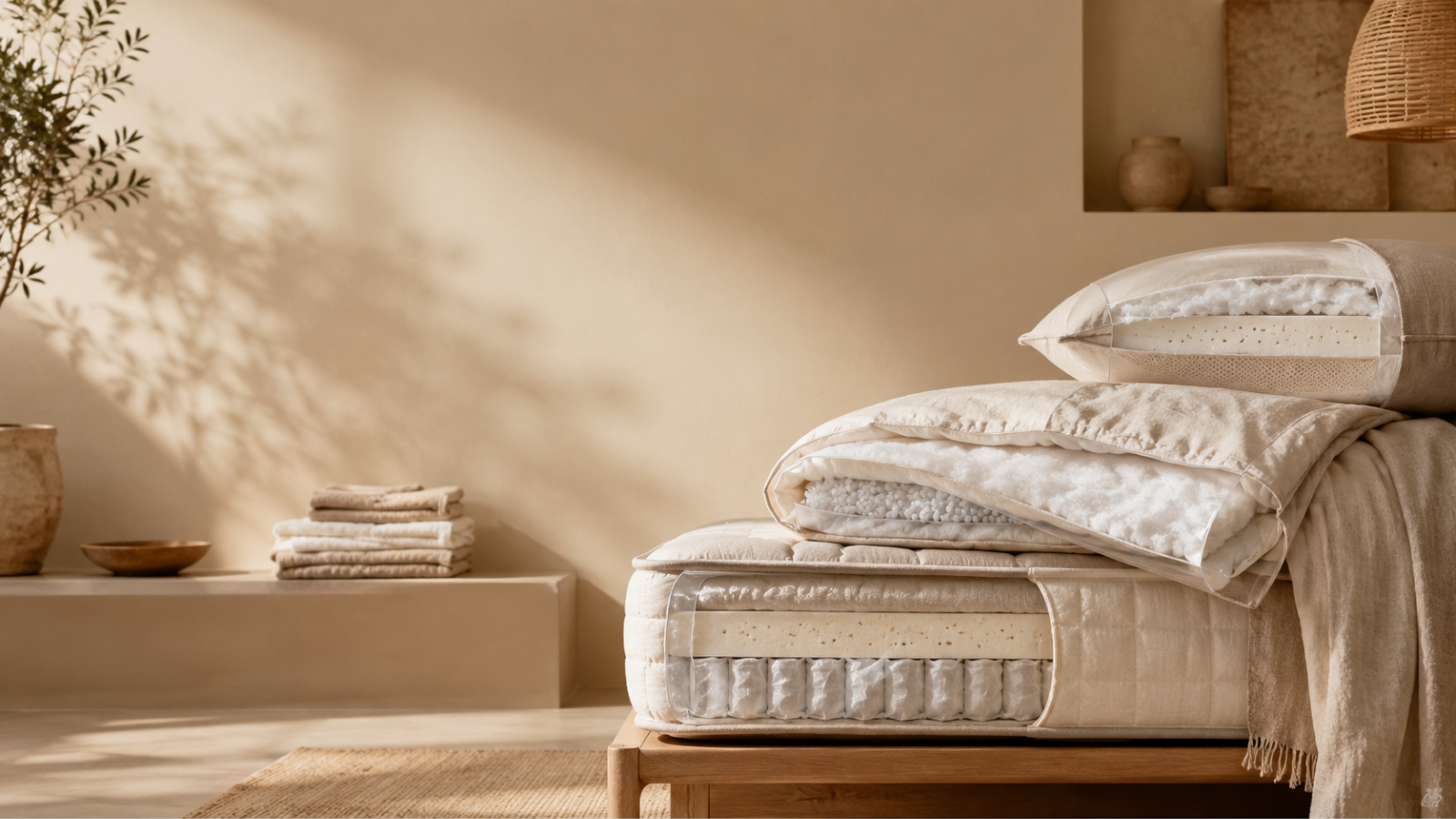
If there is one product that reveals our dependence on plastic, it is the mattress. Most mattresses contain large volumes of polyurethane foam. Polyurethane is derived from petrochemicals. Globally, millions of mattresses enter landfill each year because separating their mixed materials is expensive and difficult.
The irony?
The product we spend nearly a third of our lives on is often one of the least circular products in our home. Many consumers spend thousands seeking better sleep while rarely questioning what their mattress is actually made from.

Polyester now accounts for more than half of global fibre production. According to Textile Exchange, polyester remains the world's most widely used fibre.
The reason is simple.
It is cheap, versatile, performs well in manufacturing but polyester is plastic. Every polyester towel, sheet, blanket, cushion, robe and polyester blend originate from fossil fuels.
This isn't about guilt, it is about awareness. Once we understand what materials are made from, we can start making our own informed decisions.

One of the most surprising discoveries during our research was how many products contain synthetic materials which never appear in marketing photographs.
Elastic, thread, backing fabrics, interlinings, foam inserts, coatings, waterproof membranes, adhesives and performance finishes.
These hidden materials are rarely discussed because consumers are rarely asking. However, they play a major role in determining whether a product can ever become circular. A product is only as circular as its most difficult component to recover.

Then there is packaging, perhaps the shortest-lived material in the entire supply chain. Plastic sleeves, wraps, inserts and shipping materials. Many survive for only minutes before becoming waste and never get a second glance.
Yet they consume resources, energy and fossil fuels long before they arrive at our door. The packaging industry has made enormous progress but there is still a long way to go before premium products no longer rely on single-use plastic as the default solution.

This conversation is often framed as a waste problem but it is also a design problem. Every material choice is a design decision, every shortcut becomes part of a product's future and every hidden synthetic makes circular recovery more difficult.
The challenge facing modern manufacturing is not simply reducing waste, it is designing products which can participate in systems rather than ending in landfill.
That requires asking different questions. Not just: What does this product cost?
But:
What is it made from? Where did those materials come from? What happens when it wears out? Can it be recovered? Can it become something else?

The deeper we investigated home products, the more we realised this wasn't about towels or bedding or homewares, it was about transparency. Consumers deserve to know what products are made from, not just the hero material but all of them including the visible and the invisible ones.
I believe the future of sustainable homewares will not be built on better marketing, it will be built on better materials, better design, transparency and greater honesty.

The purpose of this article is not to tell you to throw anything away. In fact, the most sustainable product is often the one you already own. Instead, this is an invitation to open the laundry cupboard, read the labels, look beyond the headline claims, get curious and ask questions.
Once you start understanding the materials inside your home, you begin to see the entire system differently and perhaps that is where meaningful change begins, not with perfection but with curiosity.